Manufacturers Index - Nazel Engineering & Machine Works
Nazel Engineering & Machine Works
Philadelphia, PA, U.S.A.
Manufacturer Class:
Metal Working Machinery
Last Modified: Sep 26 2026 10:26PM by Jeff_Joslin
If you have information to add to this entry, please
contact the Site Historian.
|
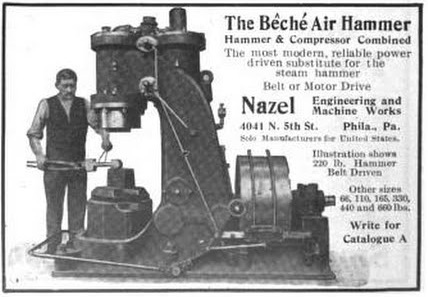 |
| Advertisement from the 1910-01-06 American Machinist |
This firm's early history is filled with a surprisingly large number of name changes. To summarize:
- 1899—Machinist and engineer John Nazel established a machine shop at 1046 Ridge Ave., Philadelphia, specializing in the design and manufacture of special tools and machinery.
- 1900—Nazel partnered with Lewis L. Bassett under the name Nazel & Bassett. They soon introduced a line of portable drills which were a predecessor to modern-day mag drills (but without the magnets).
- October 1900—Bassett left and the business was back to operating as John Nazel.
- November 1900—The business name changed to Nazel & Hulme Machine Works, with F. C. Hulme joining as partner. We have been unable to find any reliable information on Hulme.
- May 1901—The name changed to Nazel Machine Works.
- August 1902—The name changed yet again, this time to the Nazel Machine Tool Works; this name change was accompanied by an announcement that they would be introducing a line of machine tools including centering machines and keyseaters.
- November 1902—An article used the name Nazel Engineering Works, saying that they were moving into new and larger premises at Hamilton and Ridge avenues, and would shortly be introducing their new keyseater and centering machines.
- November 1903—An article used the name Nazel Engineering & Machine Works and mentioned their product lines: centering machines and portable drilling machines. They were also introducing a line of freight elevators and intended to develop hoisting machinery. As for the previously promised keyseaters, we find no evidence that they ever made it to market.
After those rapid-fire name changes the name Nazel Engineering & Machine Works would last for decades.
In 1909 the Bêché pneumatic power hammer was introduced to the US market by Nazel Engineering & Machine Works. This product, which was developed in Germany by Bêché & Grohs, proved to be important in a couple of ways. It was Nazel's first venure into the power hammer market and power hammers would become a specialty and the product they are best remembered for. The Bêché hammer is also notable as the first viable successor to the then-ubiquitous steam hammer. Using steam to power a drop-hammer was advantageous because a complicated system of valves provided exquisite control over the hammering action, even with very large hammers. The Bêché hammer replaced steam with air, integrating the required compressor and greatly reducing the required footprint compared to steam hammers, and also proving to be less expensive to run and less troublesome than steam power. Pneumatic hammers were (eventually) able to provide control that equalled that of steam hammers. The early Bêché hammers sold in the US were imported from Germany but at some point Nazel acquired the right to manufacture them in the US.
In 1923 the Nazel company acquired the Dill line of slotters from T. C. Dill Machine Co., Inc. In 1939 Nazel sold their lines of pneumatic hammers and Dill slotters to Lobdell Car Wheel Co. Nazel would survive into at least the 1950s, though more research is needed on the later history of this firm.
Information Sources
- 1895 Gopsill's Philadelphia City Directory, page 1398: "Nazel Jno. machinist, h 1813 Taney".
- 1899-11-16 American Machinist page 39-1095, small display ad. "MY SHOP is fitted with modern tools and I employ modern methods only in my work. I want to build Special Tools and Special Machines for people who want such things right. Write me at 1046 Ridge Ave., Philadelphia, Pa. / JOHN NAZEL."
- 1899-12-28 The Iron Age page 32.
Nazel & Bassett, engineers and machinists, have commenced business under very favorable auspices at 1046 Ridge avenue. Their specialty is the designing and building of machinery for power transmission, &c.
- 1900 Boyd's Business Directory of Philadelphia City. Page 47, under "Additions, Corrections": "Bassett Lewis L. (Nazel & Bassett), h 4013 Baring. Page 523: "Nazel John (Nazel & Bassett), h 2714 Montgomery av / Nazel & Bassett (John Nazel and Lewis L Bassett), engineers and machinists, 1040 to 1050 Ridge av and 435 N 11th". Nazel & Bassett is listed under Machinists; Machinery Manufacturers; Tool Manufacturers.
- 1900 issue of The Iron Age, ads section. Text ad, "Rawhide Gears / Nazel & Bassett, Engineers and Machinists, 1046 Ridge Ave., Phila., Pa."
- 1900-02-01 The Iron Trade Review page 22.
Nazel & Bassett, Philadelphia, have just received a large order for laundry machines, also one for hand portable drills.
- 1900-04-05 The Iron Trade Review page 44, text ad. "Wanted. Special Machinery and Tools to Build. / Nazel & Bassett, Engineers and Machinists, 1046 Ridge Ave., Philadelphia, Pa."
- 1900-07-26 The Iron Age pages 31-32.
Nazel & Bassett, after considerable preparation, are now in a position for manufacturing power transmission machinery, shafting, &c., and already have a good sized order for shafting for local installation. Portable drills are also now being made by this firm. Nazel & Bassett are probably the only firm in this vicinity in a position to make repairs on Daimler gasoline engines, such work heretofore being sent to New York. Judging from the fact that four Daimler engines have been repaired by this concern during the first half of July, this branch of their business should be of some value.
- 1900-10-04 The Iron Age page 27.
John Nazel, who has succeeded the firm of Nazel & Bassett, Philadelphia, Pa., manufacturer of machine tools and designer of special machinery, has in course of construction a number of new portable drills. These are designed to meet the requirements of repairs to heavy machinery parts, being attached to the part requiring drilling and operated either by power or by hand. A number of special machines for the manufacture of paper boxes are also being built.
- 1900-11-08 The Iron Age page 29.
John Nazel, Philadelphia, Pa., now has associated with him F. C. Hulme, and they are continuing the manufacture of special machinery and machine tools, under the name of the Nazel & Hulme Machine Works. They have recently completed a number of paper box machines for local delivery. These each have a capacity of 1200 to 1500 complete boxes per hour. A number of their special portable drills have also been recently delivered.
- 1901-05-23 The Iron Age page 49.
The Nazel Machine Works have made numerous deliveries of their new portable drill to local parties, and have received orders for a number of special machines for creasing pasteboard boxes.
- 1901-12-19 American Machinist page 59, text ad: "If you want GEARS cut absolutely correct, send them to Nazel Machine Works / 1046 Ridge Ave., Philadelphia."
- 1902-08-07 The Iron Trade Review page 44.
The Nazel Machine Works have changed their name and will in future will be known as the Nazel Machine Tool Works. They are about bringing out a line of machine tools, principal among which will be new designs of centering machines and keyseaters.
- 1902 issue of Machinery, page 290.
The Nazel Machine Tool Works, Philadelphia, Pa., have recently placed upon the market the centering and drilling machine illustrated herewith. This machine consists of an upright column or stand to which the bed is securely bolted. Upon this bed is mounted a drilling head and a two-jaw centering vise which can be clasped to any point along the length of the...
- 1902-11-06 American Machinist page 100.
The Nazel Engineering Works, of Philadelphia, Pa., have moved into larger quarters at Hamilton and Ridge avenues. Their new keyseater and centering machines will shortly be placed on the market.
- June 1903 The Reporter page 39, classified ad offering a used air compressor for sale, from Nazel Engineering and Machine Works, Ridge Ave. and 11th St., Philadelphia.
- 1903-11-05 American Machinist page 1583.
The Nazel Engineering & Machine Works, of Philadelphia, manufacturers of special machinery, centering machines, and portable drills, have branched out into the building of freight and passenger elevators of all kinds, hydraulic, electric, etc., and general hoisting machinery. The proprietor, Mr. John Nazel, was formerly with the Link Belt Engineering Company.
- 1905 issue of American Machinist (Volume 28 Page 827), snippet.
... centering machine designed and built by the Nazel Engineering & Machine Works, Philadelphia, Pa. This machine is primarily intended for centering driving axles of locomotives, but may be used for other axles, as it has a capacity up to 8 feet 6 inches in length, and the chucks will take axles from 4 inches to 14 inches in diameter, inclusive ...
- 1905-12-14 American Machinist page 827, has an illustrated article on the double-head centering machine from Nazel Engineering & Machine Works.
- February 1909 Machinery page 473, illustrated article on the Bêché pneumatic power hammer. This is the earliest mention of a Nazel power hammer that we have found.
- 1912 issue of Commercial Fertilizer and Plant Food Industry (Volume 5 Page 29) lists machinery exhibitors at a trade show, including "Philadelphia—Nazel Engineering and Machine Works, John Milton Nazel."
- 1928 issue of Engineers, page 371, lists "NAZEL ENGINEERING & MACH. WORKS (Nazel pneumatic power hammer, Dill traveling head slotter) Gen. Offices, 4041-51 N. 5th St., Philadelphia, Pa. Pres., J. M. Nazel V. Pres., C. H. Wackernagel Sec., H. W. Wimer Supt Mch. Shop, Robt. A. Millar."
- Mid-1930s issue of Western Machinery and Steel World page 202, has the following snippet.
...recently added by the Nazel Engineering & Machine Works, Philadelphia, Penna., to its line of self-contained motor driven air hammers. This No. 7 type "B" hammer will work mild steel up to 10 in. square. The ram has a 32in. stroke, a distance of 30 in. from the center of the ram to the housing, requires a floor space of 168 in x 68 in., and uses a 60 H.P. constant speed motor to drive it. Shipping weight is 58,300 lbs.
- 1939 issue of Western Machinery and Steel World (Volume 30 Page 224).
Nazel Engineering & Machine Works The Lobdell Car Wheel Company, Wilmington, Del., announces the purchase of the business of the Nazel Engineering & Machine Works of Philadelphia, Pa. The Lobdell Company, established in 1836...
- 1939 issue of Iron Trade and Western Machinist (Volume 105 Page 27).
Lobdell Car Wheel Co., Wilmington, Del., has purchased the business of Nazel Engineering & Machine Works, Philadelphia. Howard W. Wimer, associated with the Nazel organization 35 years, will be in charge of the Nazel hammer and Dill slotter division.
- 1942 issue of Forging, Stamping, Heat Treating (Volumes 28-29 Page 547).
Lobdell Car Wheel Company announces that it has amended its name to Lobdell Company. There is no change in the ownership or management or management of the company. The deletion of the words "Car Wheel" from the name is made to obviate confusion since the nature of the business has changed with the acquisition of the Nazel Engineering & Machine Works line of forging hammers and slotting machines.
- 1953 issue of Iron Age (Volume 171 Page 36) has the following snippet.
Forgings shown at top, left, are oxygen-free high conductivity copper and rings; those at right are finished machine K Monel Hoisting pads . . . these Forgings readily produced on a NAZEL Electro-Pneumatic Hammer by Philadelphia Bronze & Brass Corp. . . . and as displayed at the National Metal Exposition, October, 1952, Philadelphia. Hammer, Air Compressor and Electric Motor are "all one"-therefore, the NAZEL requires no boilers, compressors, tanks, piping, fuel, ash handling, shafting, pulleys, hangers, etc. The NAZEL Hammer can be started or stopped at the mere push of the button, and it uses power only when working (thing what this means in comparison with other types of hammers.) Low upkeep cost and high efficiency are outstanding features of the NAZEL. To meet industry's varied Forging Requirements. . . . we produce the NAZEL Hammer in 5 different types and 16 sizes . . . forging steel billets up to 12" x 12".
|